


| Programme (taught in English) | 2-year full-time or 3-year part-time higher diploma programme with computing, IT, multimedia, AI and their applications with Catholic values taught by caring staff with diverse expertise and passion |
| Career | Graduates are currently in great demand and have many job options |
| Further study | Graduates may articulate to either BSc(Hons)AI or BSc(Hons)DET degree programme
with perfect match in curriculum to bridge to Year 3. Graduates may also articulate to the BSc degree programme at University of Westminster, London to obtain degree in one additional year. |
| Local admission: Year 1 entry | Minimum 2222A (English, Chinese, Citizenship and Social Development and 2 other subjects) in the Hong Kong Diploma of Secondary Education Examination (HKDSEE); (or an equivalent qualification) more |
| Local student finance | Apply directly through online application. more |
| International student | Non-Chinese speaking international student may have Chinese courses substituted by other courses. more,hostels |
The gifts of human intelligence have enabled many innovations and tools in IT, AI, and design that continues to improve and affect human lives tremendously. Yet these powerful tools may also be misused such as in addiction, in pornography, in the culture of death, and in fierce competitions to prosper at the expense of defeating others. Authentic Catholic teaching encourages to live out Christian faith of love, care and helping each other in the use of high-tech in one's profession in life in serving other people and the common good of the society.
The program aims to nurture students:
Equip students with both ICT and AI skills to align with the trend in the growing job market.
Give plenty of hands-on practices to enhance the learning experience.
Provide a variety of elective courses in different areas of ICT, as the trend of ICT/AI professionals is not only in purely ICT/AI but also in the knowledge of different disciplines of applications.
Upon successful completion of the Program, students should be able to:
The higher diploma in AI and ICT programme with the up-to-date and essential discipline-based courses (including AI, data analysis, cloud, web development, networking and programming) plus the flexibility to choose from varied additional courses, will enhance career readiness of students in the fast-developing AI age when jobs in the computer science sector are increasingly expected to be well-trained in multidisciplinary applications. On completion of the Programme, graduates will be competent to purse a broad range of jobs including programmer, web page developer, database developer and system analyst.
Graduates, having met the minimum GPA requirement of 2.0, are also prepared for further studies, such as our BScAIDE and BScAI programmes offered by the School.
For admission to Year 1 of the Programme, applicants must satisfy one of the following admission requirements:
Remark:
#1. As specified in the letter of the Hong Kong Council for Accreditation of Academic and Vocational Qualifications (HKCAAVQ), the maximum number of non-standard admission (including mature aged students) for local degree programs is capped at the maximum of 15% of the actual number of Year 1 new students of the year. The cap is applied in line with the general expectation on self-financed degree-awarding institutions in safeguarding teaching and learning quality and thereby upholding the creditability and recognition of the qualifications.
To seek admission to the Program, applicants should apply via online application.
Shortlisted local applicants will be invited to attend an admission interview. Applicants are requested to bring the following when attending the interview:
The tuition
and
Scholarship
information must follow that posted at https://sfu.edu.hk
The following is only a preliminary and unofficial view provided for convenience:
The tuition fee for the 2026/27 intake of the HDAI-ICT programme is:
Full-time Year 1: $64,260
Full-time Year 2: $64,260
for a total over 2 years of: $128,520
The fee for part-time student:
Part-time Year 1: $42,840
Part-time Year 2: $42,840
Part-time Year 3: $42,840
for the total over 3 years of: $128,520
With Internal Articulation Scholarship (for recent SFU HD graduates articulating to this BSc at Year 3 entry), the tuition reduces to $20k per year.
Qualified applicants may also apply for cholarships offered by the University:
Entrance Scholarships of $30k for full-time year 1 entry with HKDSE 5 subjects total ≥ 13, year 2 entry with CGPA ≥ 2.2.
Principal's Normination Scholarship of $20k .
SFU Empowerment Scholarship of $20k for new students with good academic record (HKDSE 5 subjects total ≥ 17) and financial need.
Louis LEUNG Kwong Yoon Scholarship of $20k for new Catholic students willing to uphold Catholic values in study and in life.
South East Asia catholic Youth Scholarship to pursue academic studies at SFU in Hong Kong, free from financial constraints.
International students may apply: All courses in HDAI-ICT are taught in English, where Chinese language courses may be replaced by other courses for non-English speaking students.
The equivalent qualification to meet the admission requirements for local studentsis generally the successful completion of high school education in a 12-grade school system. It will include basic STEM courses and sufficient preparation in English proficiency to enable study in this degree program with lectures taught in English. Performance based on school transcript will be evaluated individually. Non-English speaking international students may be exempted from Chinese language study.
The annual non-local student tuition fee for the 2025/26 intake of the 2-year HDAI-ICT (or HDAI-ICT) programme is HK$96,310. (Exchange rate: HK$7.8 = US$1)
Qualified international students may apply for International Student Scholarship to waive up to 89.6% tuition. The academic performance, financial needs and motivation to study in a Catholic Institution are all considered in awarding the scholarship.
School principals and teachers are welcome to nominate their students for the international student scholarship. Both nominations and recommendations will be given due consideration.
Clergy members and lay leaders may nominate among the faithful from their parish those students with sound Christian faith, who may be interested in studying new technology. Short explanation on what you know about the candidate will help in the selection process.
International students may apply directly. For details of scholarships for international students, please enquire the Public Affairs Office and a designated staff will contact you. You may (1) send E-mail to pao@sfu.edu.hk , (2) or call (+852) 3653 6789, (3) or click the following Enquiry form to fill in and submit.
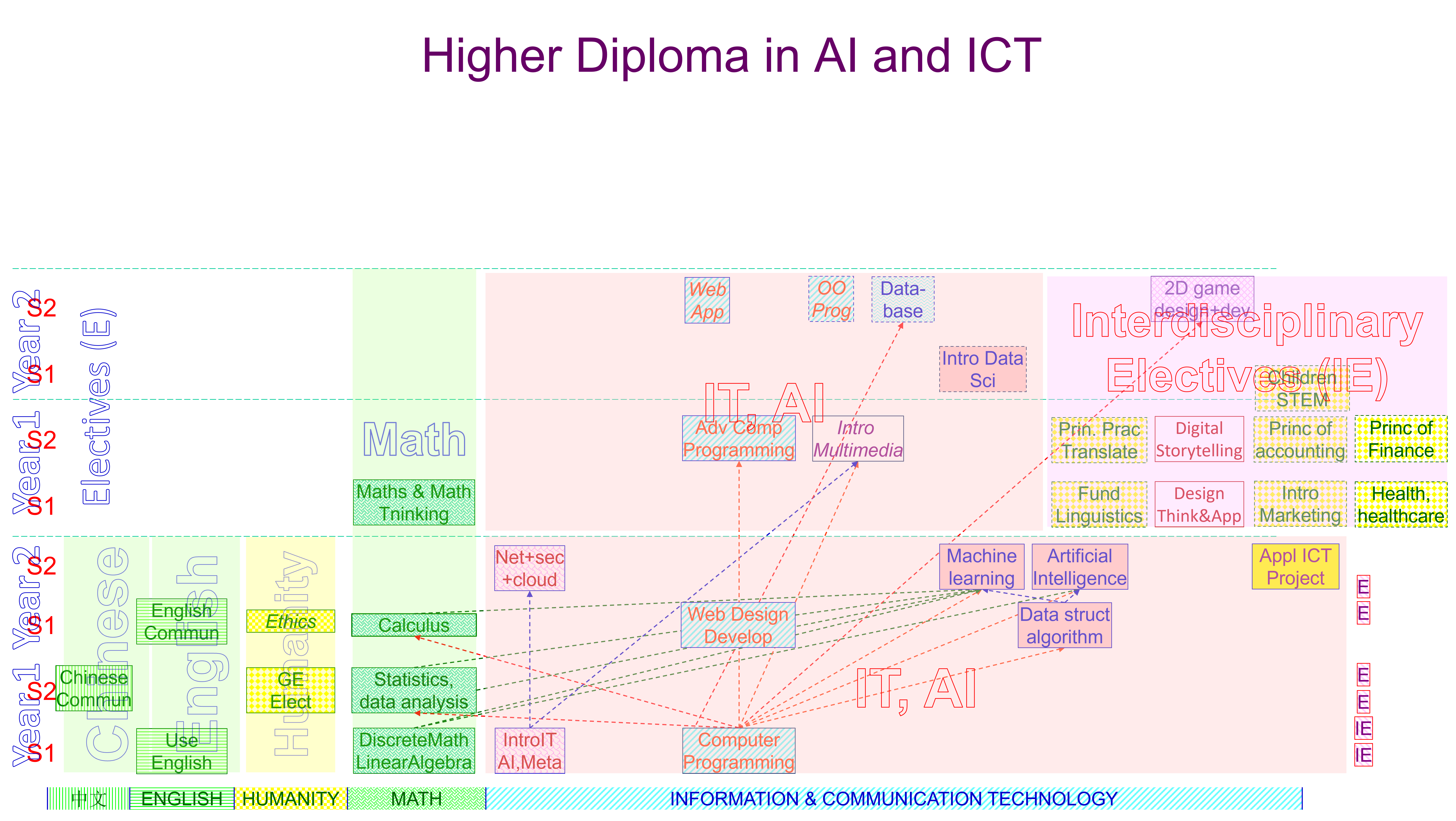
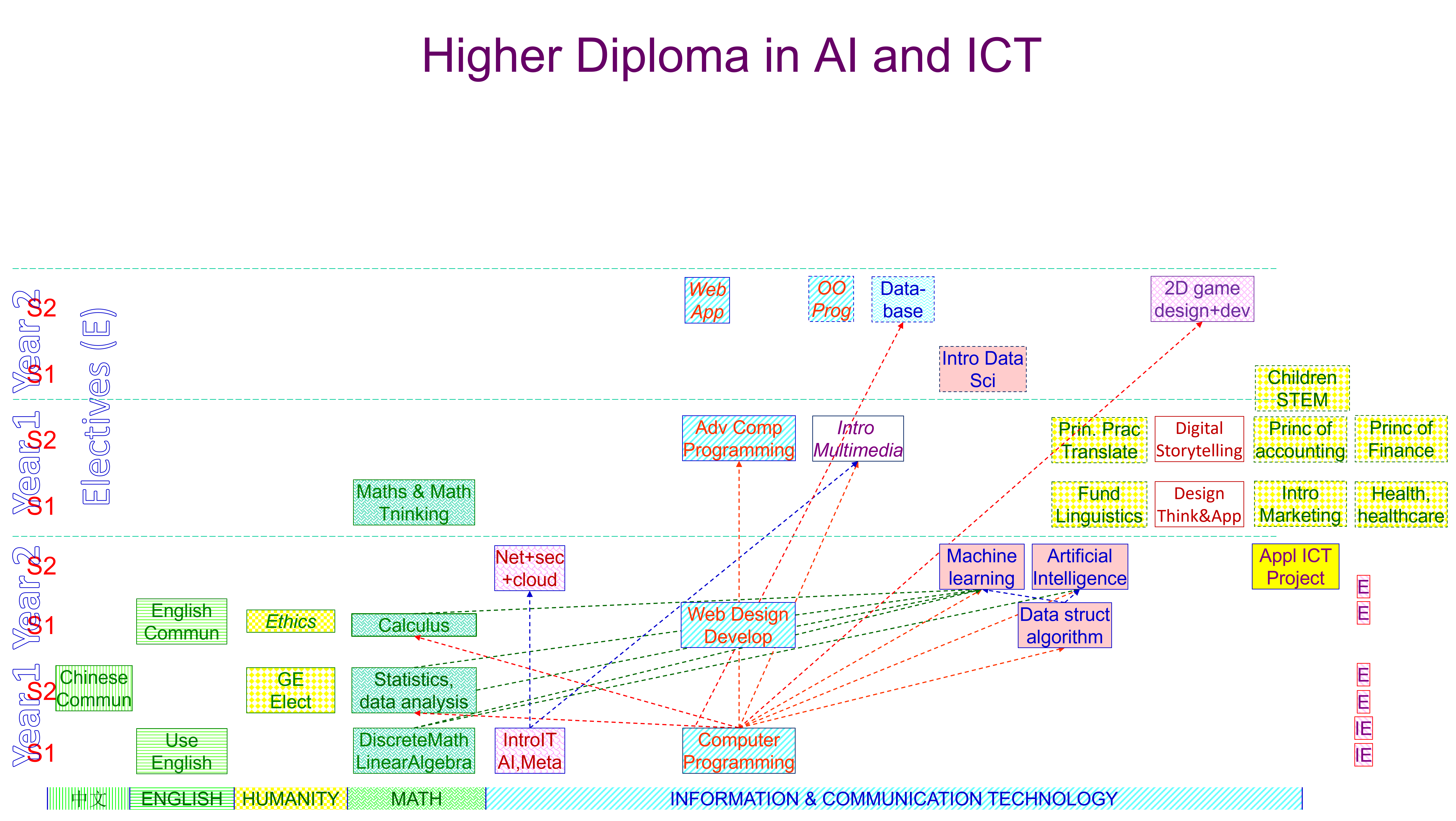
(choose at least 2 of the electives in Years 1 and 2 from AI elective courses)
(choose at least 2 of the electives in Years 1 and 2 from AI elective courses)
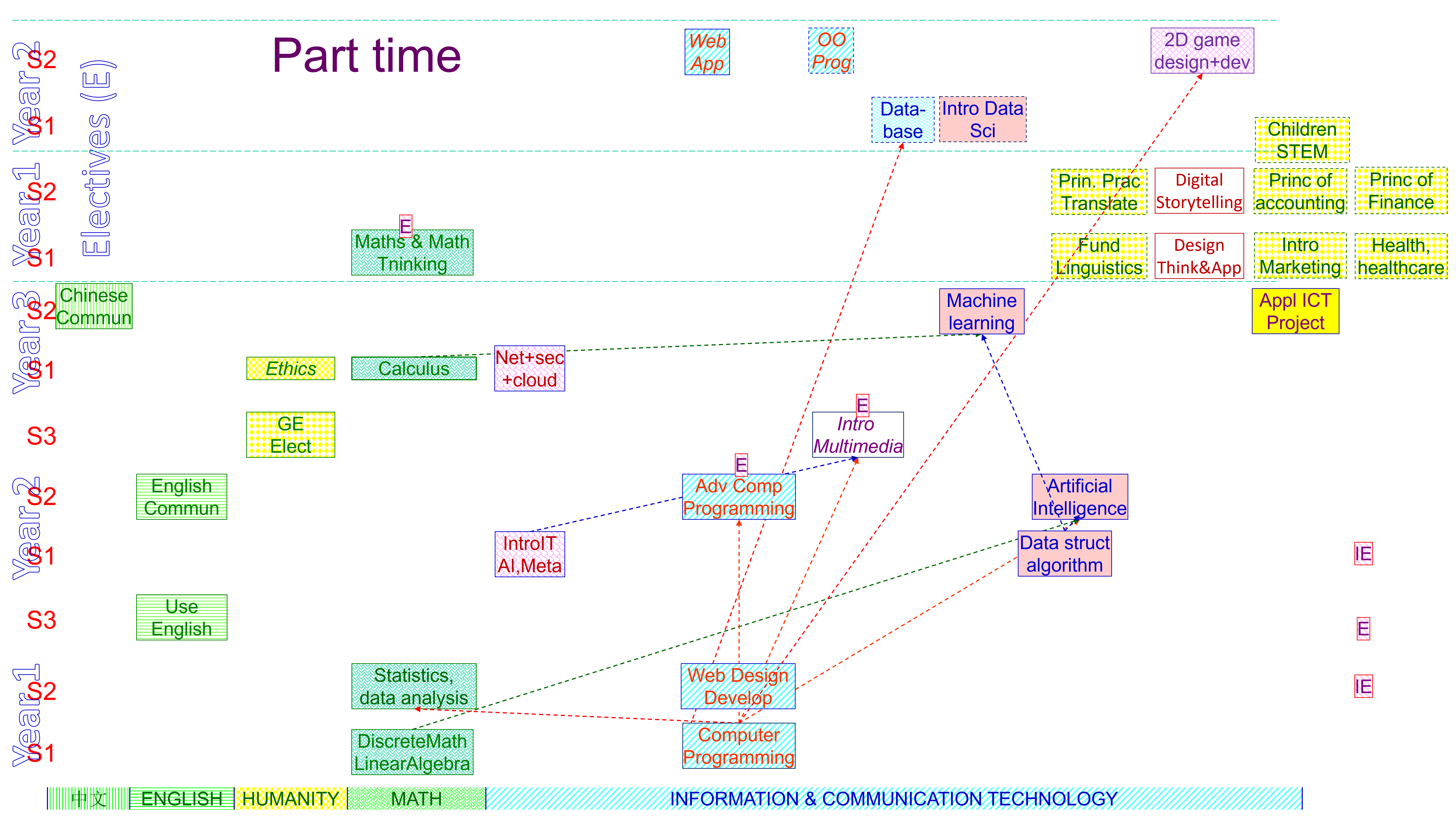
Students are highly encouraged to take the Internship course to gain industry experiences.
Industry parters are offering Internship to our students and are also hiring from our graduates.
Partial list of our industry partners are:



What is the job prospect of HDAI-ICT students? Which industry can I work in?
Programmer, Software/Web/App/Developer, Data Analyst.
If I do not meet the basic admission requirements, will I still be enable to study this higher diploma programme?
Students could study the Diploma in Foundation Studies of Higher Education and be admitted to HDAI-ICT programme when they graduate from the diploma.
Do I have a higher chance of admission in the HDAI-ICT programme if I have studied ICT? Does ICT have a higher weighting than other electives e.g. Economy?
In the selection process, the applicant's scores in two elective subjects in the Hong Kong Diploma of Secondary Education Examination will be considered as additional scores. Although prior study in ICT may help, other factors such as interview, motivation and interests of the applicant are also considered.
Would some subjects of the HDAI-ICT be exempted if I have studied some related subjects in the Diploma?
We can only exempt subjects that have QF level 4 or above.
Will there be interview after the annoucement of JUPAS result?
Yes. If students are interested in our programme, welcome to give us a call or whatsapp to 52693846, so we can arrange special interview.
I have already complete a Diploma Yi Jin or IVE, can I apply for HDAI-ICT?
One who has already complete Diploma Yi Jin may apply for HDAI-ICT.
Does the school help the BASI students buy the expensive professional softwares for their personal use?
The school has established AI laboratory and installed the needed software. Students may use the lab facilities without having to buy their own.
Would it be difficult to understand the contents if I have never studied and contacted any related topics or knowledge?
No. When we design the programme, we do not require that the students have studied any related topics or knowledge.
Can I study other courses other than the courses of HDAI-ICT if I have interest in other industries?
AI is already applied in almost every other field. Students will choose 2 interdisciplinary subjects in the first two year. Then for the students who bridge to BSc(Hon.)AI programme, they choose 2 application areas in the fourth year to apply AI to those areas such as finance, translation, healthcare, education, and engineering.
Does the school provide any supports for the HDAI-ICT students if they have the opportunity to join the Hong Kong or international competitions?
Our institute has budget to support students' competitions.
Do HDAI-ICT students have internship opputurnities in technological or digital companies?
For students who bridge to BScAI or BScAIDE in Year 3, we encourage students to intern at Year 3 summer. Our school also has connections with various IT and digital entertainment companies, and will recommend students to intern at these companies.
Is there any scholarship programme for the HDAI-ICT students?
If the new students score 13 points in the best five subjects in the DSE, they can also receive an admission scholarship of $30,000.
What are the qualifications of the academic staff of the HDAI-ICT programme?
The teaching faculty is composed of both local and international experts in AI, ICT, and 5G, including some staff with rich industry experience and Fellows of IEEE.